
Study Results
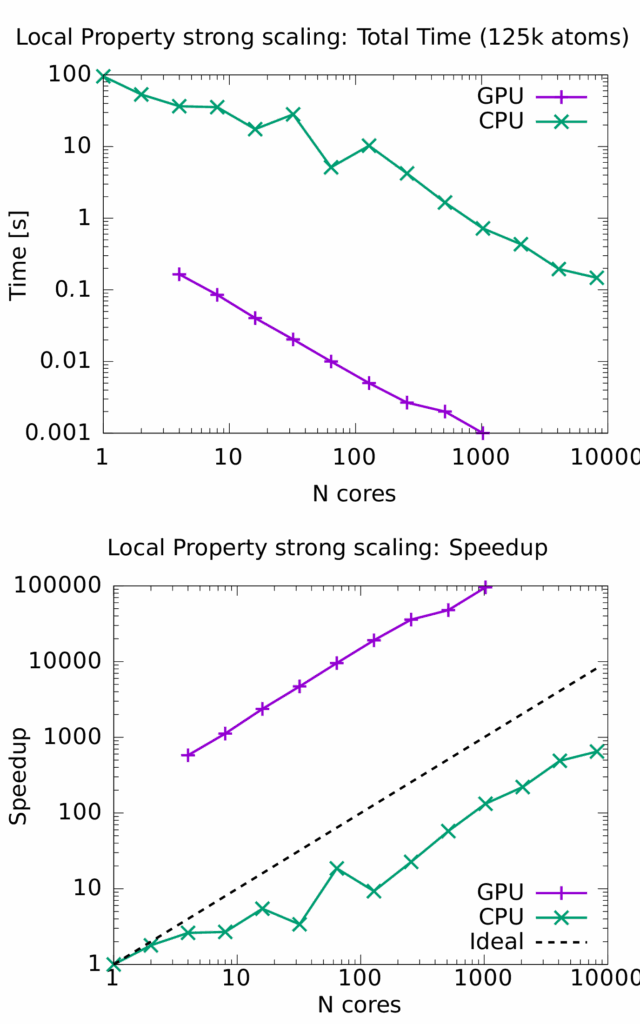
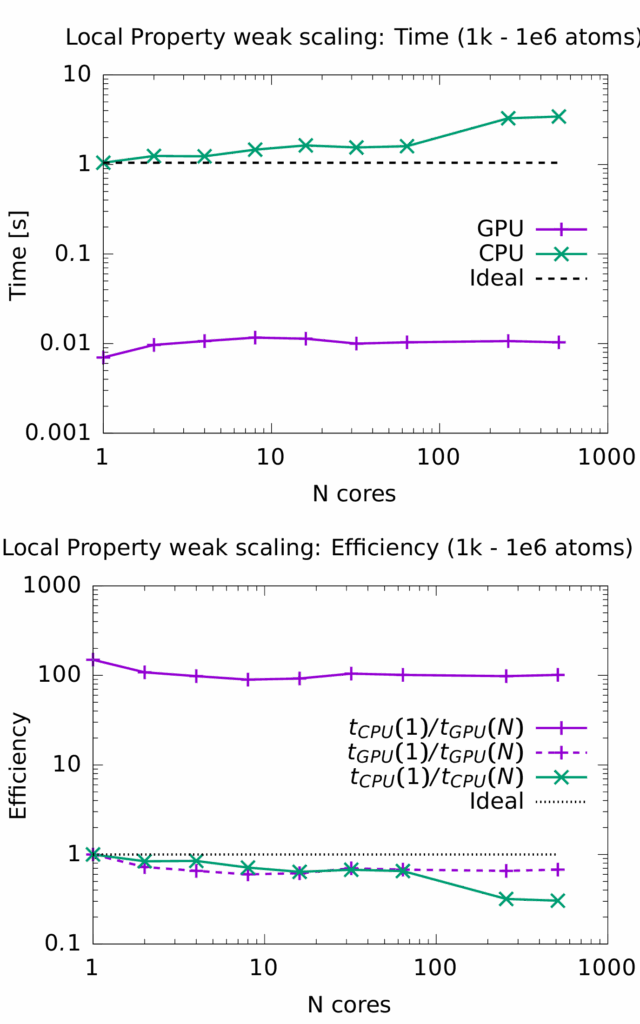
XCALE has enabled several advances in atomistic ML technology. All of the following speedups are GPU times compared with an equivalent CPU reference employing the same number of cores.
1) A new radial basis expansion and kernel linearizations were formulated and implemented, giving 10x speedups.
2) Electrostatics with support for damped charges was implemented, showing a 5x speedup.
3) For many-body van der Waals interactions a new algorithm was implemented, resulting in O(N) computational complexity compared to O(N3), which permits the implementation of experimental forces (for X-ray/neutron diffraction), which realizes atomic structural agreement with experiment. This resulted in speedups of over 100x . The GPU implementation of local atomic property prediction achieved speedups of ~300x, allowing more models to be incorporated into the experiment-driven optimization engine.
XCALE was focused on the porting of TurboGAP (turbogap.fi), an atomistic simulation engine, written in Fortran. It is designed for Gaussian Approximation Potential (GAP) machine-learning potentials, which leverage Gaussian Process Regression to predict quantum-mechanically accurate local atomic properties/energies/forces, with O(N) scaling (computational complexity), compared to O(N3). GAP models have Smooth Overlap of Atomic Positions (SOAP) descriptors which describe the local environment of atoms by a basis expansion of the local atomic density. With such accuracy, TurboGAP can perform state-of-the-art simulations, bridging the gap between experiment and simulation. The XCALE project used HIP to enable execution on both Nvidia and AMD GPU accelerators, to allow for use on (pre)exascale machines.
Benefits
Atomistic materials modelling is at a pivotal stage of its development, with data-driven approaches enabling faster and more accurate traditional simulation as well as completely new ways to understand, discover and design materials. The path to this new paradigm of atomistic modelling can be accelerated by adding physics-based functionality to overcome the intrinsic short-sightedness of machine learning force fields, on the one hand, and by seamlessly incorporating available experimental data into the simulations. This multiscale, multimodal approach to atomistic modelling promises to bridge the gap between experiment and simulation of materials. Its success hinges on the ability to access the massive computing power of new generation pre- and exa-scale supercomputers. As these are overwhelmingly based on GPU accelerators, XCALE has concentrated on adapting the algorithms and porting the software of state-of-the-art atomistic simulations as a key enabler of this transformative technology. An example of how this methodology can be used is the study of the solid electrolyte interphase plaguing the performance of metal-ion batteries (including Li-ion batteries), a research problem that the Aaolto University group is planning to tackle during the next three years. With the experimental measurements of the interface, they can use the new implementation to efficiently derive atomic-scale models to diagnose the processes that lead to slowing down of the ion diffusion and other problematic issues.
Partners
| Aalto University coordinated XCALE and contributed domain expertise in materials modelling, atomistic machine learning, and algorithmic design. The project was led by Dr Miguel Caro and Dr Tigany Zarrouk was the main contributor to the technical tasks. Patricia Hernández-León, Dr Heikki Muhli, and Dr Max Veit also contributed to the technical tasks. |
| CSC – IT Center for Science, the supercomputing center of Finland, supported the porting of the main CPU routines for GPU acceleration. Dr Jussi Heikonen coordinated CSC’s contribution to XCALE and Dr Cristian-Vasile Achim provided hands-on expertise in HPC/GPU. |
Team
- Tigany Zarrouk
- Patricia HernándezLeón
- Heikki Muhli
- Max Veit
- Cristian Achim
Contact
Name: Miguel Caro
Institution: Aalto University
Email Address: miguel.caro@aalto.fi