
Study Results
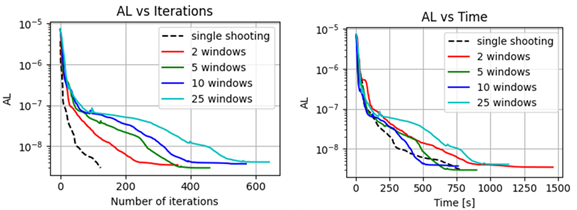
A demonstrator for velocity tracking problems with applications related to wind farm control was developed that uses parallel-in-time multiple shooting based on the augmented Lagrangian method. The demonstrator relies on the optimization package Alpaqa and the wind farm simulation package SP-Wind. The demonstrator shows weak scalability of a case on a 32x32x36 spatial grid and 32 timesteps running on a single node (96 cores) as a baseline, with 2.43M control variables. Excellent weak scalability was shown for 16 time-windows. For strong scaling, a grid of 256x256x256 was used with 256 timesteps, corresponding to 8624M control variables in a single-window run. The runs with 8 and 32 windows show decent parallel efficiency (>50%) up to 64 nodes (6144 cores).
The project also identified steps for further research and development to enable other parallel- in-time methods and latency hiding.
Codes Used:
- SP-Wind is the leading large-eddy simulation tool for wind farm simulations and control, developed in the TFSO group of prof. Meyers (Calaf et al. (2010), Delport et al. (2009), Goit et al. (2015), Munters et al. (2018)). The code is efficiently parallelized (in space) using 3D domain decomposition.
- Alpaqa4Scale is an open-source C++ library implementing the alpaqa solvers for numerical optimization (Pas et al. (2022)), with added support for distributed memory systems. It includes a novel PowerALM solver (Bodard et al. (2024)).
- ParaOpt is an extension of the time-parallel Parareal method to optimal control. An efficient preconditioner was developed for the nonlinear case by the NUMA group (Bonte et al. (2024)). An open-source proof-of-concept implementation is available.
Benefits
The goal of the project was to obtain a potential order of magnitude speed-up of LES-based optimal control of wind farms and enabling real-time use. This is illustrated by the demonstrator case based on the velocity tracking cases in Janssens & Meyers (10.1016/j.cpc.2023.109019), that are solved using the parallel-in-time multiple shooting approach implemented in alpaqa4scale based on the augmented Lagrangian approach. When projected onto wind farm control, these speed-ups may contribute to a real-time LES-based control loop, which in turn would lead to significant energy gains that can be realized in practice.
Furthermore, by decoupling the optimization and time-parallelism from the flow solver, the interface between alpaqa4scale and SP-Wind also facilitates future developments. In particular, we envision the following:
- Development of Sequential Quadratic Programming (SQP) for parallel-in-time multiple shooting, as a promising alternative for the augmented Lagrangian approach.
- Development of four-dimensional variational data assimilation algorithms for state estimation in the context of wind farm control.
Partners
| KU Leuven is a leading research-intensive university in Belgium, renowned for its advanced High Performance Computing (HPC) capabilities that support cutting-edge scientific and industrial research. The university hosts the ‘Genius’ supercomputer, a Tier-2 HPC cluster integrated into the Flemish Supercomputing Center (VSC). This system delivers approximately 600 teraflops of compute power, featuring 96 CPU nodes and 20 GPU nodes equipped with NVIDIA Tesla P100 accelerators. It facilitates complex simulations and AI-driven research across disciplines such as molecular modeling, astrophysics, climate science, and engineering. |
Team
- ·Giovanni Samaey
- Johan Meyers
- Panos Patrinos
- ·Karl Meerbergen
- Pieter Pas
- ·Nick Janssens
- Steven Vandenbrande
- Kobe Bergmans
Contact
Name: Karl Meerbergen
Institution: KU Leuven
Email Address: Karl.Meerbergen@kuleuven.be