
Study Results
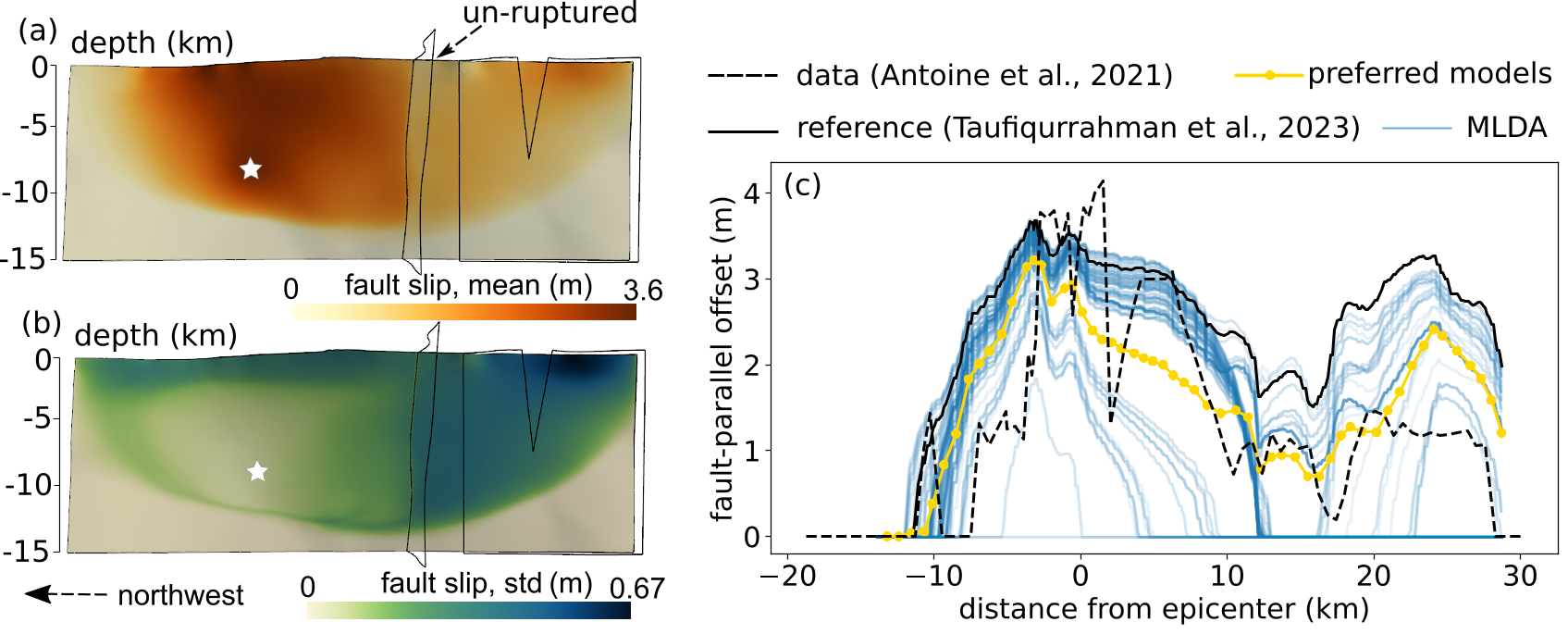
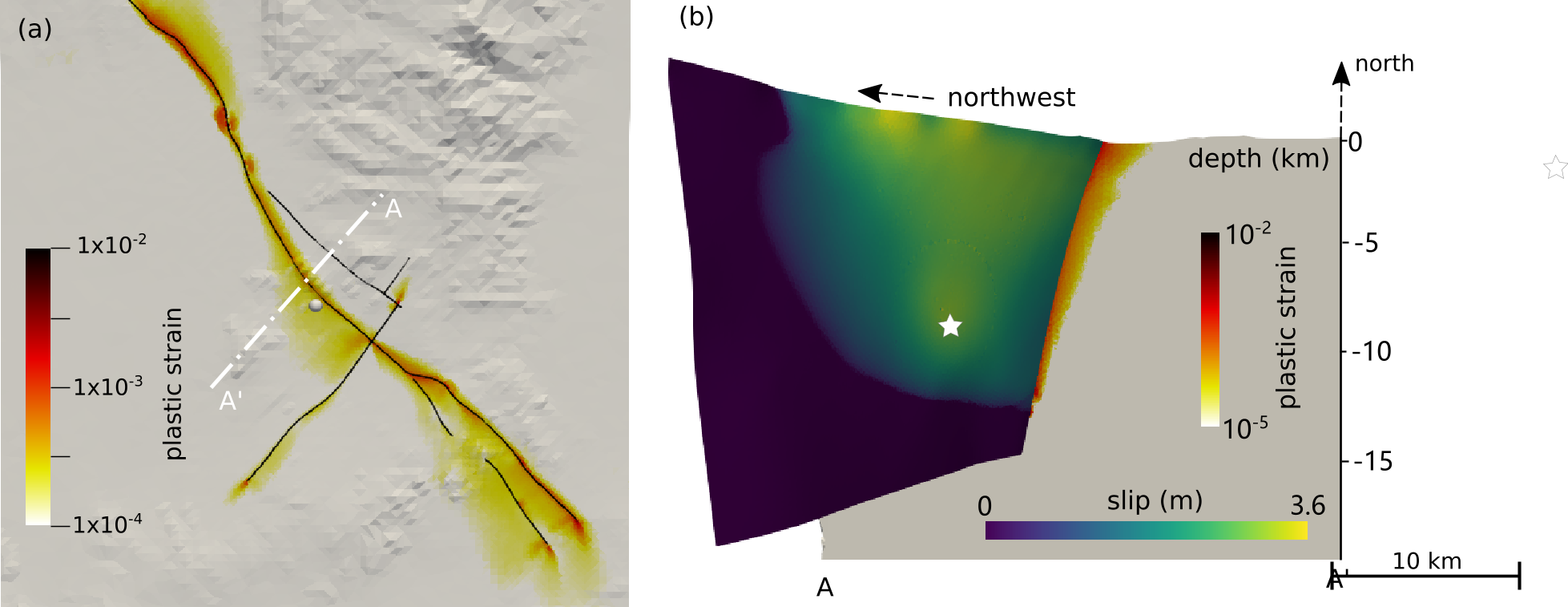
We enable Bayesian inference for complex simulation models by pushing the efficiency of UQ algorithms and harnessing the power of modern supercomputers. Specifically, we have developed a new approach to parallelizing a hierarchical UQ method for Bayesian inference, overcoming inherent data dependencies. We have made our implementation publicly available as a Python package. Building on the UM-Bridge interface, users across all disciplines can apply our package to perform Bayesian inference using any simulator and any compute cluster. In addition, we have kick-started development of a new UQ method exploiting higher-dimensional model hierarchies, promising further efficiency gains. On the simulation side, we enable effective use of advanced hardware features in SeisSol, a state-of-the-art simulator for earthquake phenomena. Finally, we have gained new insights about underlying model parameters in the 2019 Ridgecrest earthquake event. All results will be published in forthcoming papers, one of which is already accepted.
Benefits
- We enable efficient Bayesian inference for large-scale simulation, allowing researchers and engineers across disciplines to infer unknown parameters from data in complex models, while accounting for model ambiguities and measurement errors. Leveraging our novel parallelization, users can infer parameters for more compute-heavy models, leading to better insights in fields such as climate science, engineering, and biomedicine.
- Our hardware-aware optimizations for earthquake simulations improve SeisSol’s performance on modern GPU-based supercomputers. As an immediate consequence, this enables more precise and lower-cost earthquake simulations. More broadly, our approach of fused simulation runs applies to a wide range of applications, providing a recipe for researchers from other fields to obtain similar performance gains.
- We facilitate large-scale inference for earthquakes, allowing geophysicists to derive deeper insights into seismic events. Our approach to hierarchical UQ provides a scalable framework for estimating earthquake parameters, improving forecasting, and ultimately informing policymakers to develop risk assessments and mitigations.
Partners
| Karlsruhe Institute of Technology Uncertainty quantification (UQ) expert. Development of innovative and scalable uncertainty quantification algorithms and advances to the UM-Bridge platform linking UQ to large-scale simulators. |
| Technical University of Munich HPC expert. Hardware-aware optimization of SeisSol earthquake simulations. |
| Ludwig Maximilians Universität Munich Seismology expert. Earthquake modeling and design of Bayesian inference problems. |
Team
- Linus Seelinger
- Michael Bader
- Alice Gabriel
Contact
Name: Linus Seelinger
Institution: Karlsruhe Institute of Technology
Email Address: linus.seelinger@kit.edu