
Study Results
AaltoAstI has finalized the design, development, and benchmarking of the HPC pipeline utilizing PC-A and ODOP and deployed it to production use within EuroHPC supercomputers. As will be shown in a peer-reviewed journal publication in preparation, performance and scale-up tests show that the developed HPC pipeline is utilizable on Exascale supercomputers and can lead up to more than two times reduction of the time-to-solution by overlapping the simulation and data analysis tasks, the latter previously done in post-processing but now performed on-the-fly.
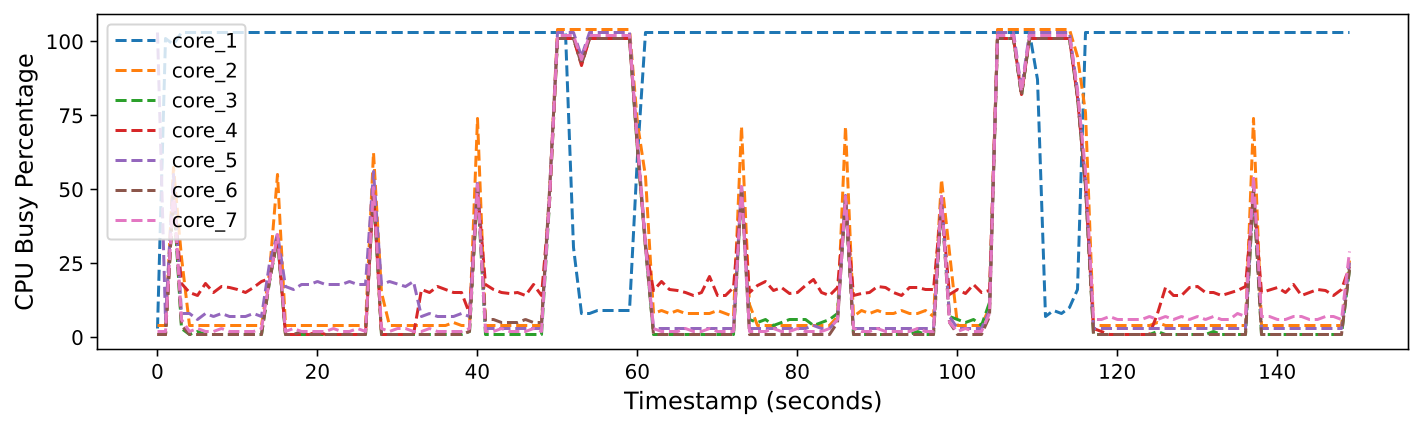
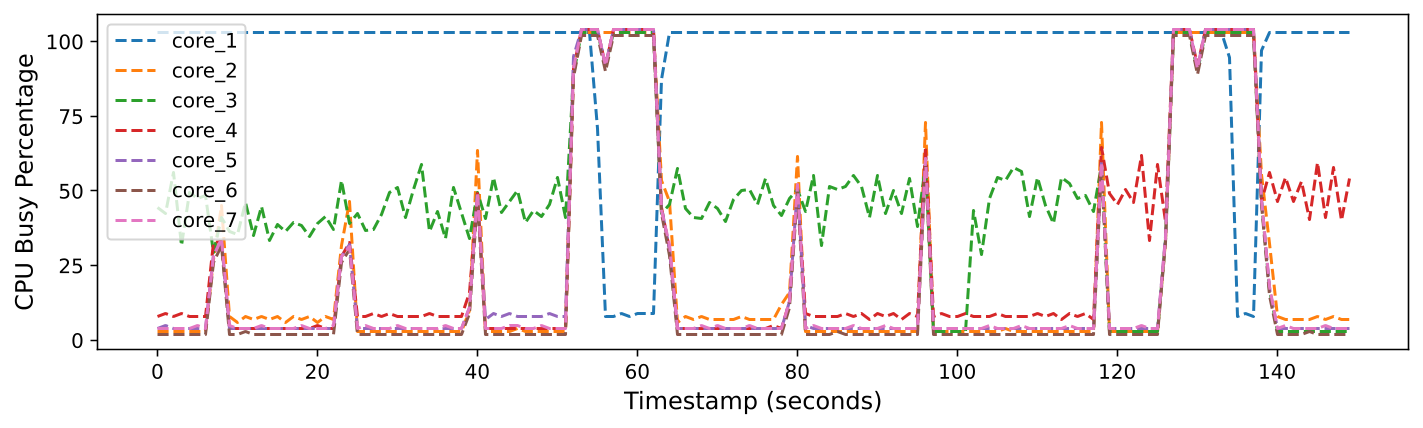
AaltoSEA has developed an ODOP framework to help domain scientists identify and specify opportunistic tasks (optasks) involving intensive data operations within HPC applications. The framework includes a lightweight monitoring tool that can be integrated into the applications to measure resource usage across compute nodes and processes. This allows ODOP to detect underutilized resources and allocate them to optasks. We benchmarked ODOP with PC-A and GPT-2 fine-tuning applications, with results published at “Minh-Tri Nguyen, Anh-Dung Nguyen, Jarno Rantaharju, Touko Puro, Matthias Rheinhardt, Maarit Korpi-Lagg, Hong-Linh Truong, “Supporting Opportunistic Data Operations for Data-Intensive Computational Applications,” in 2024 IEEE International Conference on Big Data (Big-Data), Washington, DC, USA, 2024, pp. 3735-3744, doi: 10.1109/BigData62323.2024.10826079” and in a technical report on task scheduling.
CSC has supported the AaltoAstI and AaltoSEA teams in HPC and LUMI related technical aspects and integrating the developed technologies into CSC’s computing environment. More precisely, by wrapping ODOP using a container wrapper, which reduces the load on the shared file system of LUMI. Additionally, CSC has provided assistance with SLURM and multithreading and multi-GPU submission scripts. The NEOSC pipeline can improve the efficiency of applications and resource utilization for HPC resource providers leading to energy savings and increased throughput.
Codes Used:
- Astaroth is a multi-GPU library for stencil computations for multiphysics simulations. It is the main computational engine used in the HPC pipeline
- Pencil Code is a high-order finite-difference code for compressible hydrodynamic flows with magnetic fields and particles parallelized on CPUs utilizing MPI and multi- threading through openMP. Astaroth is interfaced to Pencil-Code to achieve efficient performance on CPUs and GPUs
- ODOP is a framework supporting the developer/scientist to explore free resources allocated for their long-running applications to carry out data operations in an opportunistic manner
https://github.com/rdsea/odop/
Benefits
- The data analysis bottleneck will plague application domain production runs with many different setups on Exascale computers. During this project, we have developed and demonstrated an efficient and scalable solution to attack this problem. We also obtained scientifically significant results from the first production runs utilizing this concept.
- The value added to science is to have had integration support and computing resources from the CSC/LUMI consortium in undertaking these pioneering efforts.
- The added value to Exascale supercomputing centers is to provide solutions for their users to overcome the upcoming data analysis bottleneck, whenever they shall have production-ready GPU- or otherwise accelerated applications ready for serious production runs.
Partners
| AaltoAstI develops and applies HPC tools for magnetized fluids often encountered in astrophysical and technological applications. |
| AaltoSEA researches runtime and optimization techniques for data systems, cloud-HPC continuum, and software systems. |
| CSC – IT Center for Science Ltd. offers supercomputing resources, scientific software and the related support and training to Finnish university researchers. |
Team
- Maarit Korpi-Lagg
- Touko Puro
- Matthias Rheinhardt
- Anh-Dung Nguyen
- Minh-Tri Nguyen
- Jarno Rantaharju
- Hong-Linh Truong
- Jussi Heikonen
- Juhana Lankinen
Contact
Name: Maarit Korpi-Lagg
Institution: Aalto University, Head of the HPC Lab at the Department of Computer Science at Aalto.
Email Address: maarit.korpi-lagg@aalto.fi