
Study Results
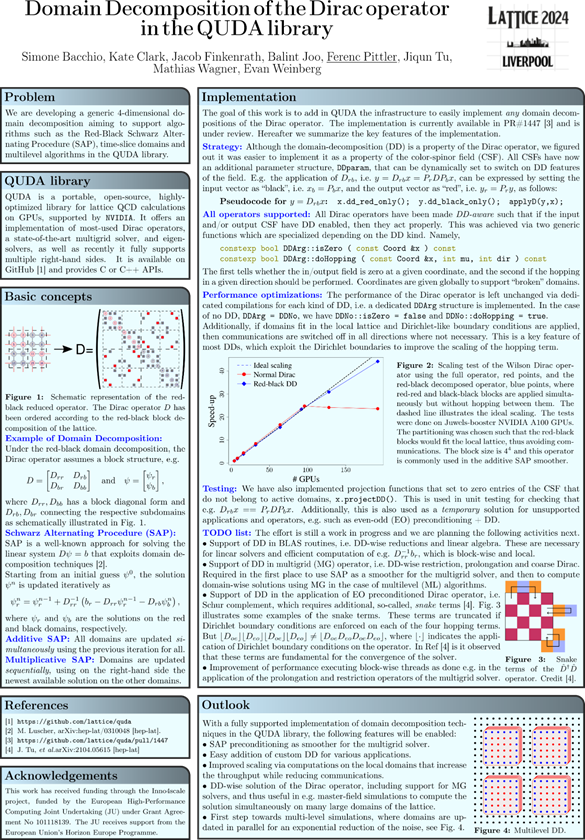
MG4ML developed highly scalable, noise-reduction-oriented algorithms for large-scale Lattice QCD simulations tailored for exascale systems. The first objective achieved was to create an optimized, flexible 4-dimensional multilevel block decomposition of the Dirac operator within the QUDA library. This decomposition enables more efficient computation of Lattice QCD observables and acts as an effective noise-reduction technique by introducing active and frozen regions. The second objective achieved was to apply multigrid techniques within the multilevel block decomposition. Multigrid methods effectively restrict low modes of the Dirac operator to coarse grids, enhancing computational efficiency in simulations with light quark masses. Additionally, incorporating low-mode averaging via multigrid methods further reduces noise in key observables by efficiently increasing statistics on low modes.
Lattice QCD efficiently exploits GPUs to accelerate computations, particularly through the QUDA library, which is optimized for NVIDIA GPUs using CUDA. QUDA provides highly optimized solvers for Dirac operators, crucial for simulating quarks and gluons on a discretized lattice. It supports various fermion discretizations, including Wilson, Clover, Staggered, and Domain Wall, leveraging GPU parallelism for significant speedups over CPU-only approaches. European HPC systems like Leonardo, MareNostrum 5, and LUMI integrate GPU acceleration into their lattice QCD workflows, enabling large-scale simulations of hadron structure. QUDA’s fine-tuned algorithms reduce memory bandwidth bottlenecks and optimize multi-GPU scaling, making it indispensable for modern lattice QCD research. More details on QUDA: GitHub QUDA.
Benefits
The MG4ML outcomes enhance the efficiency and precision of Lattice QCD simulations, with far-reaching benefits across multiple domains:
Furthermore, the project’s progress in noise-reduction techniques and scalable solvers contributes to public administration initiatives in scientific computing. By fostering collaboration between academia and supercomputing centers, these advancements help optimize resource utilization in national and international HPC facilities, promoting more efficient and impactful computational research.
In fundamental science, one aim is to refine precision calculations in hadronic physics, improving theoretical predictions that can be directly compared with experimental data from leading facilities such as CERN and JLab. By enabling more accurate determinations of hadron properties, the MG4ML advancements support efforts to test the Standard Model and search for physics beyond it.
In high-performance computing, the advanced numerical solvers we developed have applications beyond Lattice QCD. The optimized domain decomposition and multigrid techniques can improve solver performance in fields such as fluid dynamics, climate modeling, and material science, where large-scale numerical simulations face similar computational challenges.
Partners
| The Cyprus Institute (CyI, https://cyi.ac.cy): Dr. Simone Bacchio (PI), Dr. Ferenc Pittler (R&D), Prof. Giannis Koutsou (HPC & domain expert). |
| Bergische Universität Wuppertal (BUW, https://www.uni-wuppertal.de): Dr. Jacob Finkenrath (Co-PI), Dr. Juan Andrés Urrea Niño (R&D), Prof. Andreas Frommer (Domain expert), Prof. Francesco Knechtli (domain expert). |
| QUDA Library Developers (https://github.com/lattice/quda): Dr. Kate Clark (QUDA & NVIDIA developer, Software provider), Dr. Mathias Wagner (QUDA & NVIDIA developer), Dr. Evan Weinberg (QUDA & NVIDIA developer), Dr. Balint Joo (QUDA developer, HPC expert), Dr. Jiqun Tu (QUDA & NVIDIA developer). |
| Extended Twisted Mass Collaboration (ETMC, https://inspirehep.net/experi ments/1513946): Prof. C. Alexandrou (Cyprus, Domain expert), Prof. Roberto Frezzotti (Italy, Domain expert), Prof. Carsten Urbach (Germany, Domain expert). |
| HPC providers: EuroHPC (https://eurohpc-ju.europa.eu), BSC (Spain), JSC (Germany), CINECA (Italy), CSCS (Switzerland). |
Contact
Name: Simone Bacchio
Institution: The Cyprus Institute
Email Address:s.bacchio@cyi.ac.cy