
Study Results
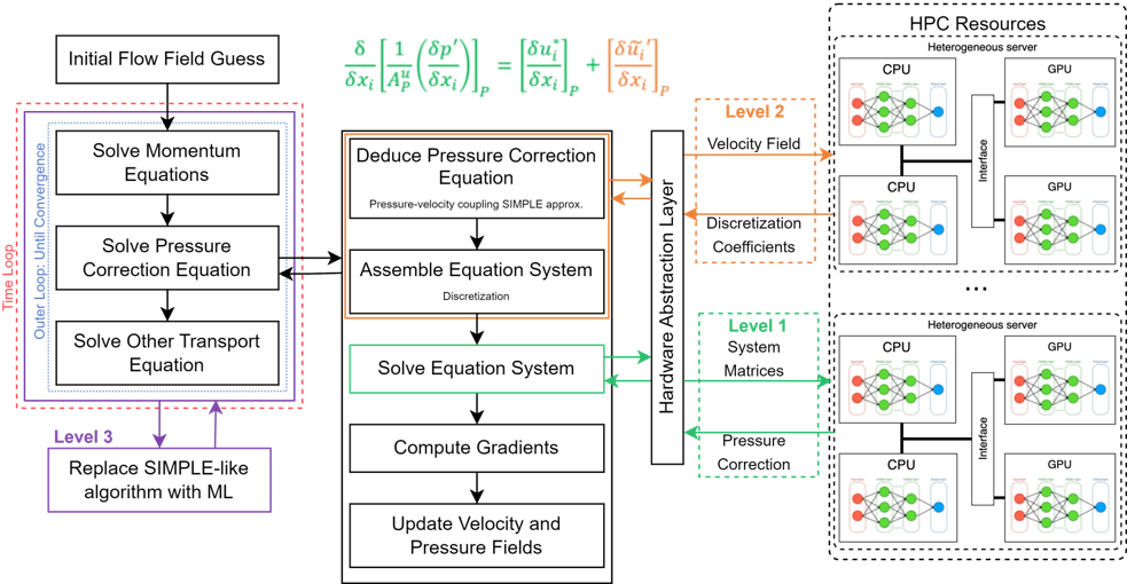
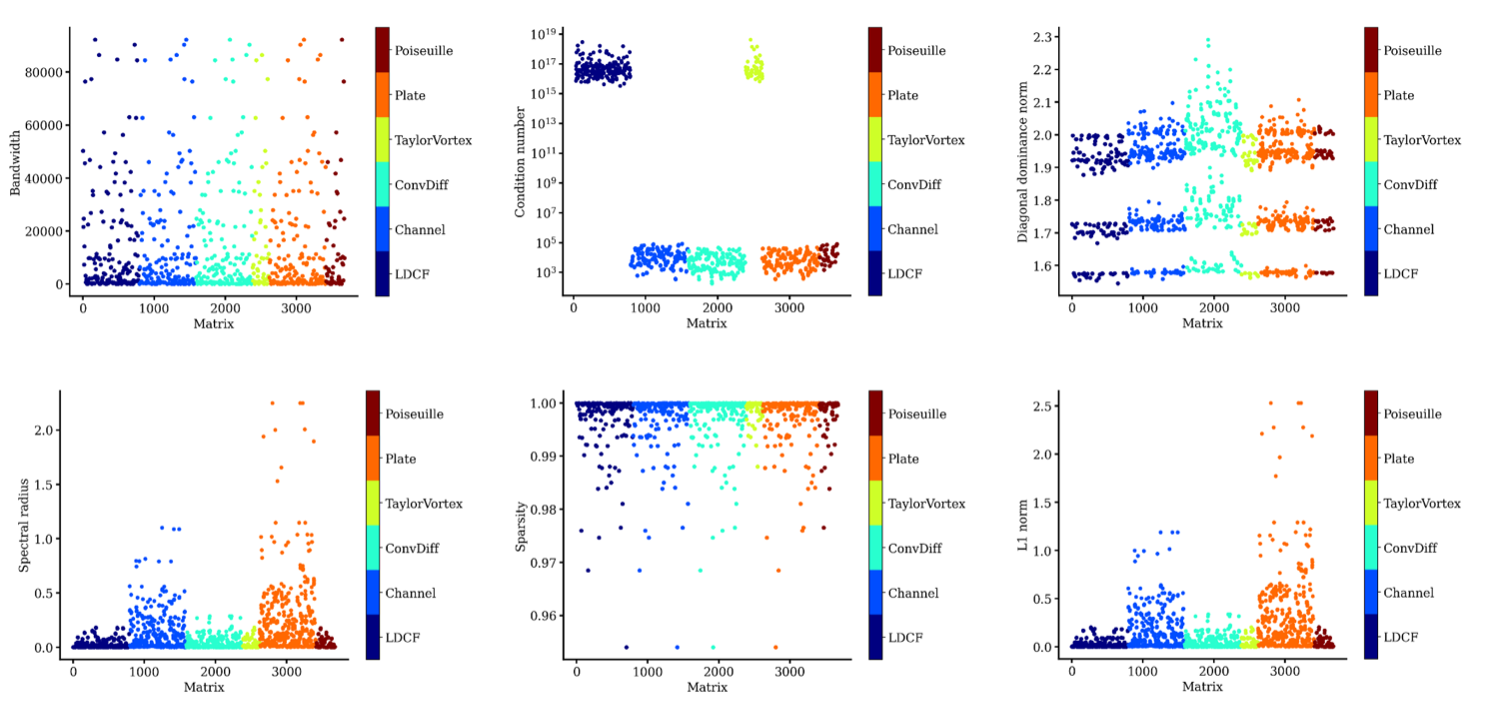
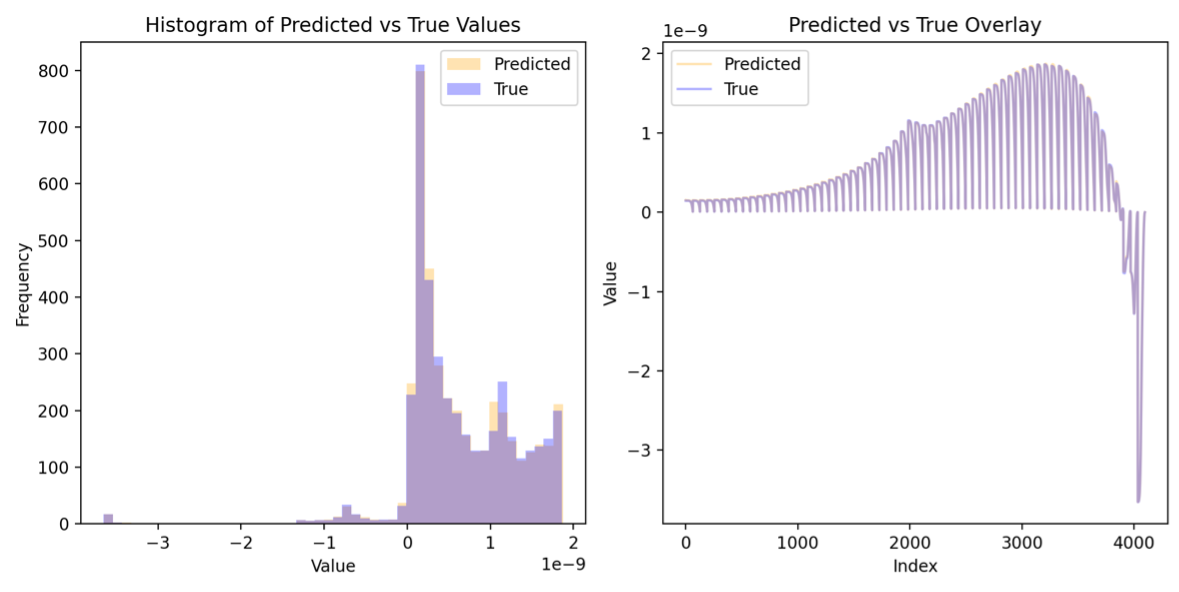
The study has demonstrated that Graph Neural Networks can be integrated into CFD solvers for solving linearized equation systems. The trained algorithm infers solution vectors based solely on the matrix coefficients and right-hand-side vectors, entirely on the GPU. This enables greater flexibility and performance in using hybrid CPU-GPU architectures within CFD simulations. While the approach shows clear promise, further data and optimisation are needed to improve inference accuracy and performance.
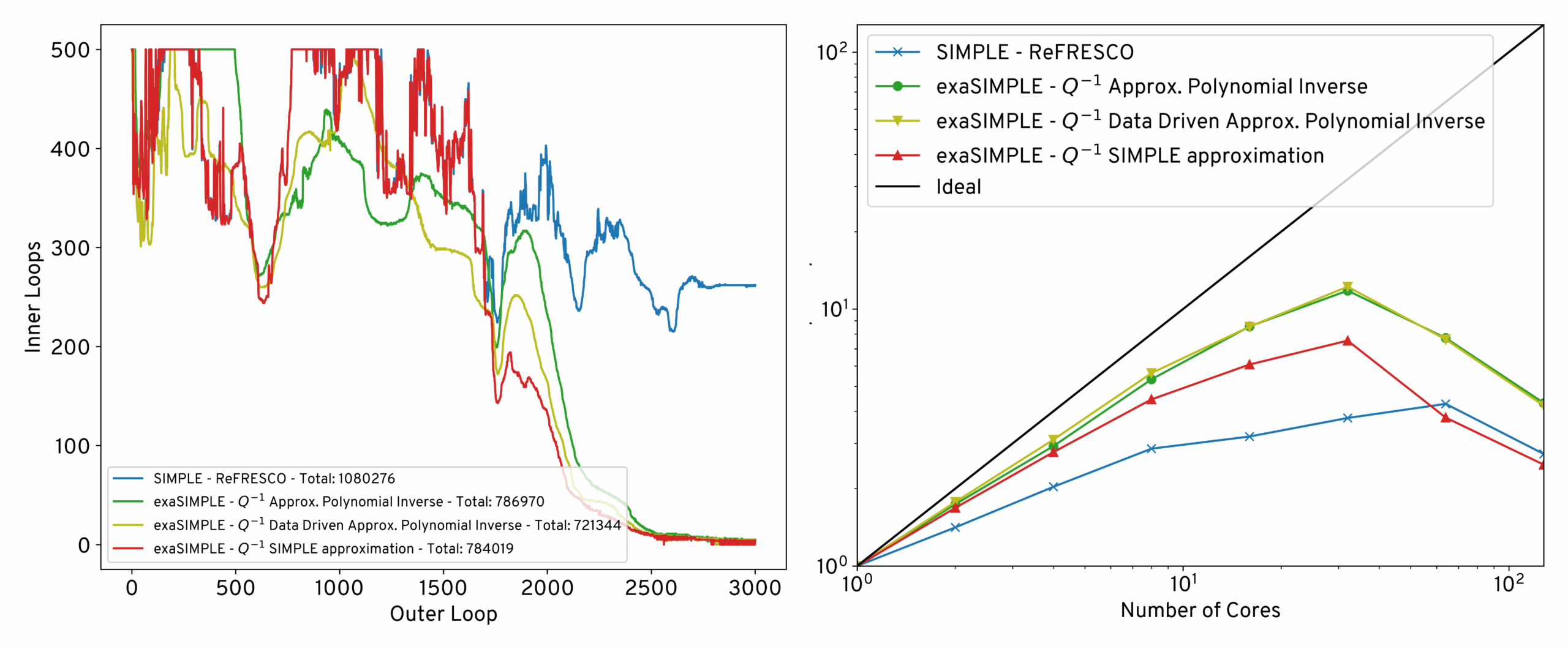
In addition, by reducing simplifications commonly made in the traditional SIMPLE algorithm, and by approximating terms typically omitted, the number of pressure correction and nonlinear solver loops required to achieve convergence has been reduced for all tested cases. Higher underrelaxation factors could also be applied without negatively impacting numerical stability. These results are considered highly encouraging and will be submitted for publication in a scientific journal.
Benefits
The proposed methodology to accelerate the SIMPLE algorithm may have significant implications for CFD practitioners. It promises more robust and reliable simulations, with fewer failures and lower computational costs. In the longer term, it may expand the scope of CFD applications, particularly in optimisation and operational contexts, where faster turnaround and higher accuracy are critical.
Beyond CFD, the work may also impact other scientific fields that rely on solving large matrix equation systems. PETSc, a key library used in this study, is applied across various domains such as medicine, astronomy, and electromagnetics. If the machine learning matrix solvers developed here can be further refined and incorporated into PETSc, their impact could extend well beyond fluid dynamics.
Partners
| blueOASIS, a Portuguese SME, acts as the project coordinator and brings together over 100 years of aggregated knowledge in AI, scientific programming, and CFD. The company focuses on renewable energy and has substantial experience in developing algorithms and software for fluid dynamics, high-performance computing, and machine learning. In the context of exaSIMPLE, blueOASIS leads the development and serves as the primary domain expert. |
| INESC TEC, an Associate Laboratory in Portugal with more than 35 years of experience in research and technology transfer, contributes to the project through its high-performance computing team. This team operates the Minho Advanced Computing Center and manages the Deucalion EuroHPC supercomputer. INESC TEC’s main role in exaSIMPLE is to ensure efficient software–hardware integration, acting as the project’s HPC expert and infrastructure provider. |
| MARIN (Maritime Research Institute Netherlands) is a highly experienced independent research institute specialising in hydrodynamic research. Having developed in-house CFD codes since the 1980s, MARIN contributes deep expertise in maritime and offshore CFD applications. Their role in exaSIMPLE is to ensure that the project aligns with industry needs and to strengthen its real-world applicability and impact. |
Team
- Guilherme Beleza Vaz
- João Muralha
- Astrid van Toor
- Artur Lidtke
- André Pereira
Contact
Name: Guilherme Nuno Vasconcelos Beleza Vaz
Institution: blueOASIS (www.blueoasis.pt)
Email Address: gvaz@blueoasis.pt