
Study Results
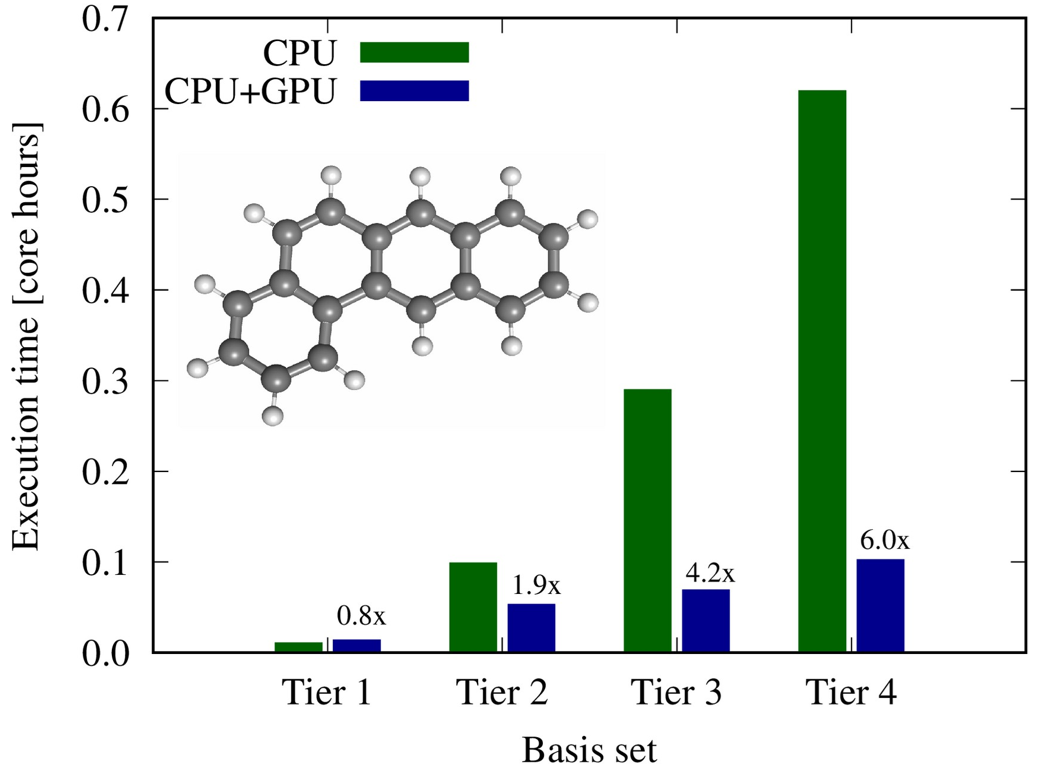
The newly developed W-engine has been integrated into the GreenX library and linked to both CP2K and FHI-aims, making the low-scaling algorithms immediately available in those codes. A key achievement is the improved Γ-point convergence scheme: by implementing an efficient treatment of the Coulomb singularity, the team reduced the required k-point mesh for periodic 2D systems with no loss in accuracy, cutting down computation time by a factor of 3. They also achieved comprehensive GPU acceleration of the most expensive O(N3) phases of the GW workflow – testing showed up to an 8× speed-up when enabling GPU offloading, compared to CPU-only execution. In strong-scaling tests, the improved code scaled efficiently from 8 cores to 1024 cores, reducing a representative GW band structure calculation from over 25 hours (on 8 cores) to just 23 minutes on 1024 cores.
The study built upon existing open-source electronic structure codes and state-of-the-art HPC software. In particular, the team used the CP2K quantum chemistry software (https://github.com/cp2k/cp2k, which employs Gaussian-type orbitals and is highly optimized for massively parallel HPC execution) and the FHI-aims code (https://fhi-aims.org/, all-electron code with numeric atom-centered orbitals). These codes were extended via the GreenX library (https://github.com/nomad-coe/greenX) – an open-source library for many-body Green’s function methods – in which the new W-engine module was implemented.
Benefits
Scientific impact: Researchers in computational physics and materials chemistry can now tackle simulations of atomically thin materials with an order of magnitude smaller computational cost. By enabling accurate quasiparticle calculations of these materials, Exa4GW opens the door to discovering and understanding novel quantum effects in 2D materials and semiconductor heterostructures.
Industrial and societal benefits: The ability to simulate large interfaces with GW precision can accelerate R&D in semiconductor and energy industries. Engineers designing next-generation solar cells, batteries, or photodetectors will benefit from quantitative predictions of band offsets and defect energetics at material junctions. By reducing the time and compute resources required for such simulations by orders of magnitude, Exa4GW makes high-level theory more accessible outside academia as well – potentially enabling industrial researchers to incorporate GW calculations into their materials design workflow.
Public sector and HPC ecosystem: Exa4GW contributes to European leadership in high-performance computing and computational materials science. The project showcases effective use of EuroHPC pre-exascale infrastructure for solving domain-specific grand challenges, thereby justifying and maximizing the return on investment in HPC hardware.
Partners
| TU Dresden (Golze Group) – Coordinator, junior research group led by Dr. Dorothea Golze at TU Dresden’s Chair of Theoretical Chemistry, focused on developing highly accurate methods for theoretical spectroscopy of materials and implementing them for massively parallel execution on HPC platforms. The Golze group contributed to core aspects of GW code development (notably in the all-electron FHI-aims code and the CP2K code) and led the integration of the new “W-engine” module and GPU acceleration. |
| University of Regensburg (Wilhelm Group) – Partner, junior research group led by Dr. Jan Wilhelm at University of Regensburg’s Institute of Theoretical Physics, specializing in large-scale electronic structure method development for systems with hundreds to thousands of atoms. The Wilhelm group brought expertise in low-scaling GW algorithms (in CP2K) and focused on the methodological improvements and benchmarking on realistic materials interfaces. |
Team
- Dr. Francisco Antonio Delesma Diaz
- MSc Moritz Leucke
- MSc Qing-Long Liu
- Dr. Rémi Pasquie
- Shridhar Sanjay Shanbhag
Contact
Name: Dr. Dorothea Golze
Institution: TU Dresden
Email Address: dorothea.golze@tu-dresden.de