
Study Results
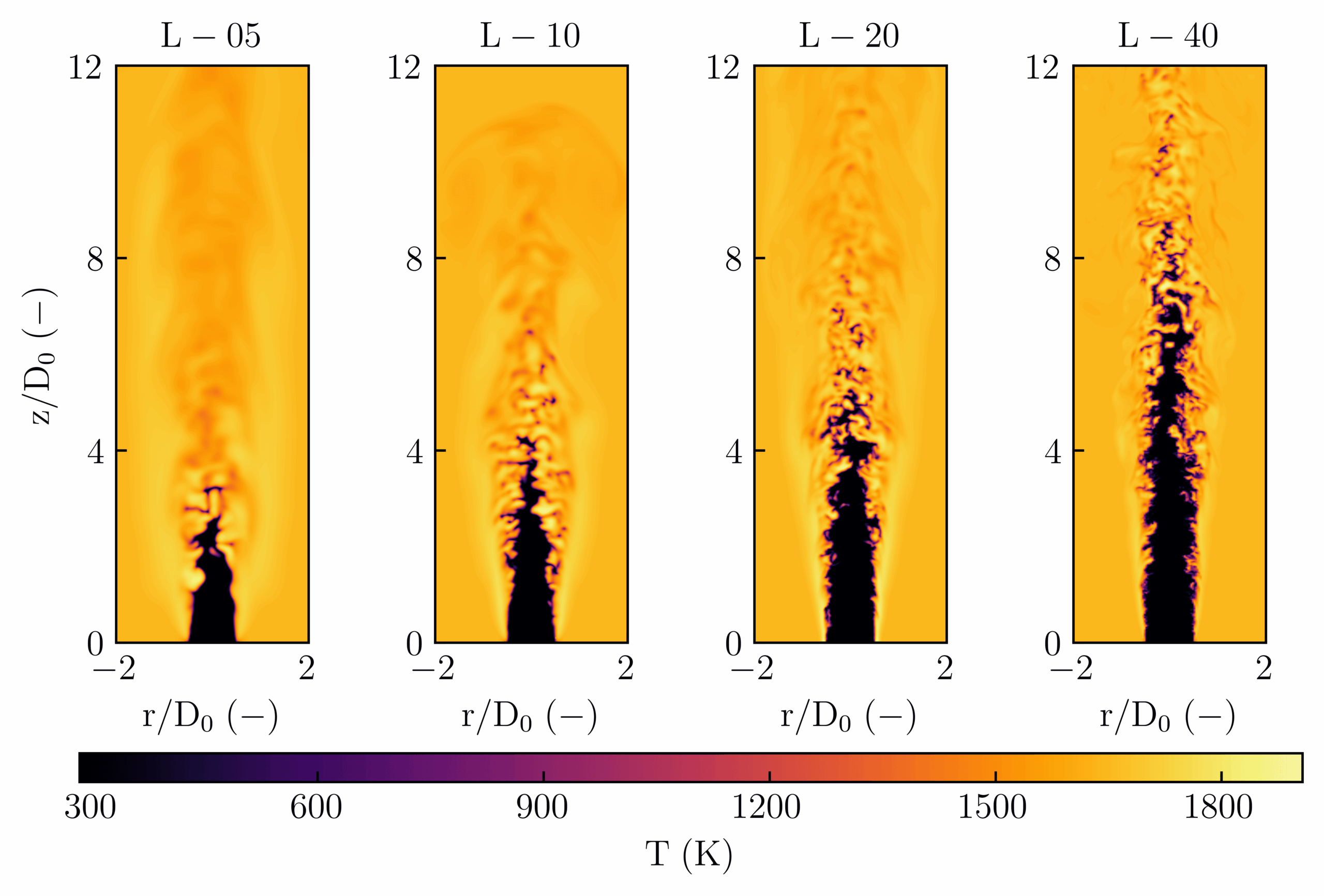
The study successfully developed and deployed a GPU-optimized spectral element solver capable of simulating turbulent hydrogen combustion with detailed chemistry at scale. Integrated into the NekRS framework via the NekCRF plugin, the solver demonstrated excellent performance, achieving near-roofline efficiency and strong scalability on leading European HPC systems. Simulations covered a wide range of operating conditions, enabling high-fidelity direct numerical simulations (DNS) of hydrogen flames. These results provide deep insight into flame dynamics and pollutant formation, supporting the development of predictive combustion models. The solver achieved efficient weak and strong scaling up to 886 nodes (3544 A100 GPUs) and performed approximately twice as fast on GH200 GPUs, confirming its exascale readiness. The generated DNS database is among the first of its kind for hydrogen and serves as a reference for model validation. Additionally, the work enabled a successful application to an early access exascale program, underscoring its technical maturity and relevance. The project outcomes pave the way for future simulations of more complex fuels and chemical mechanisms, while establishing a robust foundation for advancing exascale combustion modeling in Europe.
The project used NekRS, a GPU-accelerated spectral element flow solver written in C++, with compute kernels implemented via the Open Concurrent Compute Abstraction (OCCA) library. OCCA enables runtime selection and just-in-time compilation of parallel kernels in CUDA, HIP, OpenCL, or CPU backends. NekRS employs hybrid MPI+X parallelism, assigning one MPI rank per GPU. The NekCRF chemistry plugin is fully integrated and uses CVODE from the SUNDIALS library to solve coupled transport equations for temperature and species. It supports efficient reactive flow simulation via approximate Jacobian-vector products, a low- precision FP32 Krylov basis for GMRES, and overlapping MPI communication. For I/O, the solver uses Adios2, and for in-situ visualization and data analysis, it integrates Ascent. Third- party dependencies include HYPRE, SUNDIALS, and OCCA, and the codebase requires standard POSIX-compliant systems with CMake, GCC, and MPI 3.1+. The full simulation workflow is optimized for GPU-resident computation, with minimal data transfer to the host. More information is available at: https://github.com/NekRS/nekRS.
Benefits
This study delivers several key benefits across science, industry, and public administration. For the scientific community, it provides a powerful, scalable tool for simulating turbulent reacting flows with detailed chemistry, enabling fundamental research into flame dynamics, pollutant formation, and combustion instability. The generated DNS database for hydrogen combustion offers a unique benchmark for developing and validating next-generation combustion models. For industry, the solver supports the design and optimization of carbon- free propulsion and energy systems, particularly gas turbines and engines running on hydrogen or alternative fuels. Its ability to run high-fidelity simulations at realistic conditions reduces reliance on expensive experiments and accelerates development cycles. Public administration benefits through the study’s contribution to climate goals, supporting clean energy strategies by improving predictive capabilities for emerging hydrogen technologies. The project also reinforces Europe’s leadership in exascale computing, demonstrating how investments in HPC infrastructure translate into real-world impact across energy, research, and innovation policy.
Partners
| TU Darmstadt, acting as domain and application experts, focused on high-fidelity modeling of hydrogen combustion, data analysis, and model development, with strong links to industrial stakeholders. |
| The Supercomputing Centre at Forschungszentrum Jülich served as the HPC provider, enabling large-scale simulations and scalability testing on cutting-edge GPU architectures. The Jülich team contributed expertise in exascale readiness, numerical methods, and performance analysis, and led coordination with the JUPITER Research and Early Access Program. |
Team
- Prof. Dr.-Ing. Christian Hasse, TU Darmstadt
- Dr.-Ing. Hendrik Nicolai, TU Darmstadt
- Driss Kaddar, TU Darmstadt
- Mathis Bode, Forschungszentrum Jülich
Contact
Name: Prof. Dr.-Ing. Christian Hasse
Institution: Simulation of reactive thermo-fluid systems
Email Address: hasse@stfs.tu-darmstadt.de